BREAKING! Princess Anne Collapses as an Urgent Royal Crisis Unfolds—A Dark Night Falls Over London. Prince Andrew Has Just Been Confirmed to Have…
Unseen Pressures: Rumors and Reality Behind Prince Andrew’s Public Appearance
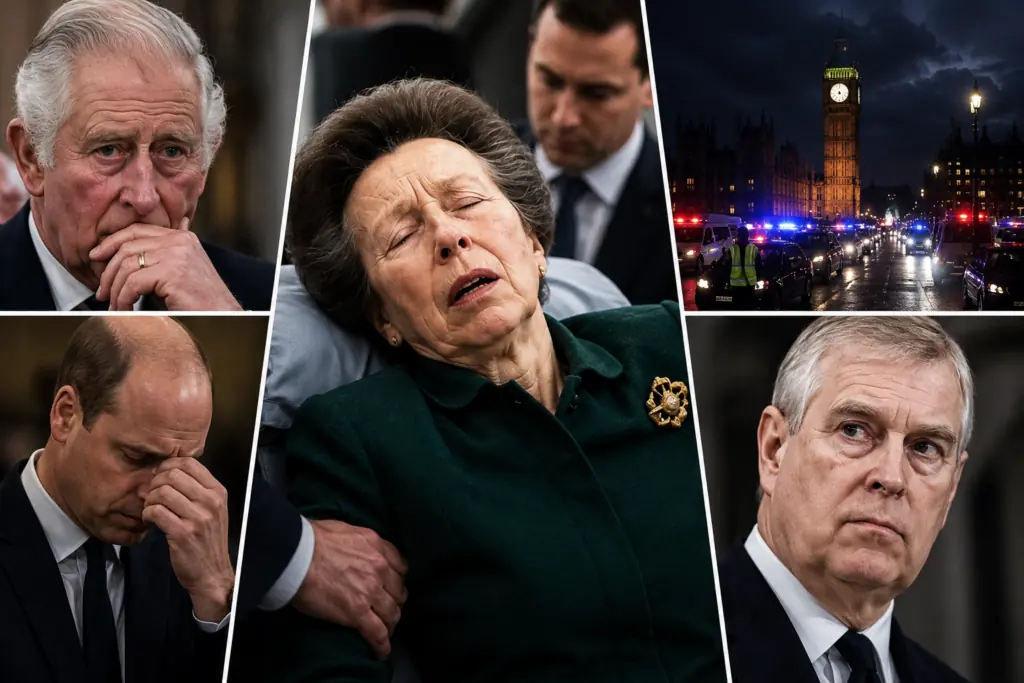
In recent days, royal observers and global news outlets have fixated on a compelling visual detail: visible bruising on the cheek of Prince Andrew, the Duke of York. Captured in candid photographs during a drive near the Royal Lodge in Windsor, the subtle yet noticeable mark immediately sparked widespread speculation across social media and international tabloids.
In an era where every movement, gesture, and appearance of high-profile public figures is scrutinized under a microscopic lens, a simple physical mark can quickly evolve into a narrative of its own. Beyond the sensationalism, Prince Andrew’s recent appearance underscores the intense ongoing public interest surrounding his life, his health, and his deeply altered role within the modern British Monarchy.
The Photograph That Triggered a Wave of Speculation
The image in question—showing Prince Andrew behind the wheel of his Range Rover—quickly circulated across digital platforms. Commentators and royal watchers were quick to point out a faint, purplish discoloration on his facial cheek, prompting an immediate flurry of questions.
While minor bumps, scrapes, or bruises are common occurrences for individuals of any age, the dramatic media environment surrounding Prince Andrew transformed the observation into a topic of intense discussion.
Common Hypotheses vs. Tabloid Drama
- Routine Minor Mishaps: Medical experts and objective commentators frequently note that minor facial bruising in older adults can result from everyday incidents—such as a minor fall, an accidental bump during daily activities, or routine sports and equestrian endeavors.
- Speculative Narratives: In contrast, tabloid commentary rapidly constructed dramatic, unverified scenarios, attempting to link the physical mark to internal stress, personal conflict, or high-stakes private disputes.
This stark contrast highlights how the public persona of a fallen royal turns even the most mundane physical details into fodder for grand narrative speculation.
The Heavy Weight of Isolation and Public Scrutiny
To fully understand why a simple physical mark attracts such intense global focus, one must examine the broader context of Prince Andrew’s current life. Following his complete step-back from public duties and the surrender of his military affiliations and royal patronages in recent years, the Duke of York has led an increasingly secluded existence.
Living primarily at the Royal Lodge on the Windsor estate, Prince Andrew’s public outings are now largely restricted to private estate grounds, equestrian rides, and occasional family gatherings.
“When a public figure transitions from constant ceremonial visibility to profound isolation, every rare public glimpse becomes an event,” noted one veteran media analyst. “A minor scratch or bruise is no longer just a physical detail—it becomes a symbol through which the public projects its curiosity.”
The relentless attention demonstrates that despite withdrawing from official royal duties, Prince Andrew remains incapable of fully escaping the public eye. The intense curiosity surrounding his well-being reflects an enduring fascination with the personal consequences faced by individuals who fall from the pinnacle of royal privilege.
The Royal Family’s Stance on Personal Privacy
In keeping with longstanding traditions, Buckingham Palace and official royal communications channels have maintained complete silence regarding the speculative reports about the Duke’s appearance. The monarchy’s established policy on non-official, private health matters remains firm: routine personal injuries or minor medical details involving non-working royals do not warrant public commentary.